
Our Story
Founded on Mission. Built on Experience. Driven by Innovation.
HOME / Who We Are / Leadership
The story of Celeris Systems begins with two engineers, a shared commitment to mission success, and a determination to solve some of the most complex challenges facing our nation's defense programs.
Where It All Began
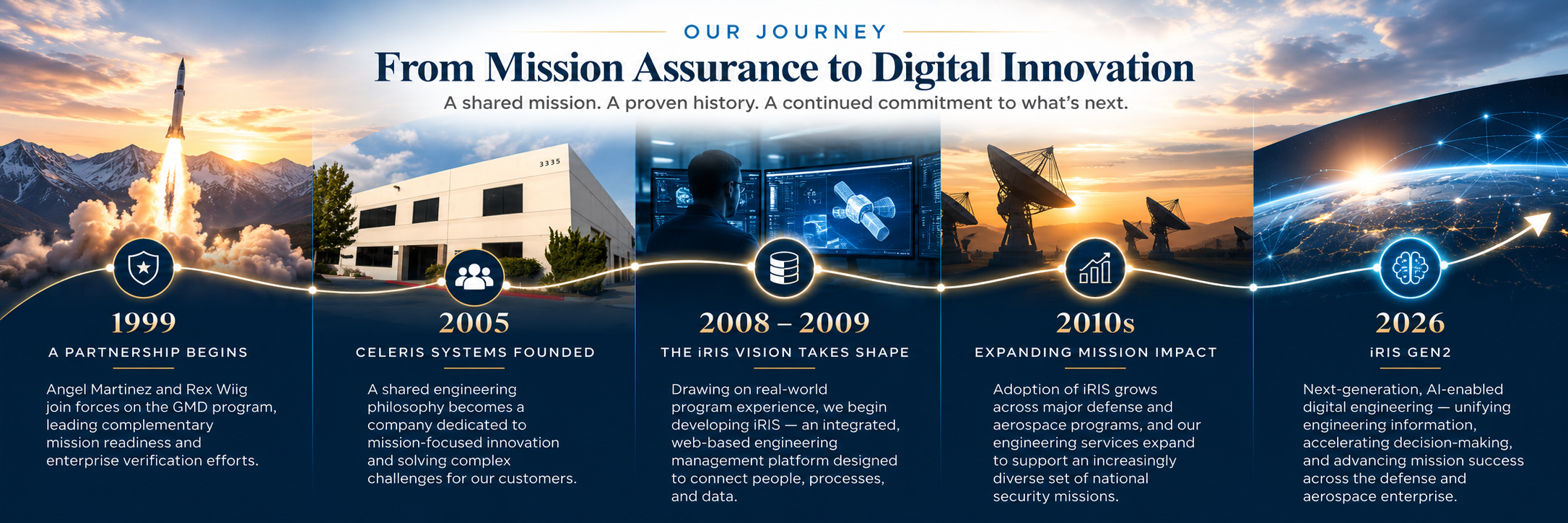
In 1999, Angel Martinez and Rex Wiig crossed paths while supporting one of the nation's most consequential defense initiatives: the U.S. Ground-based Midcourse Defense (GMD) Program. Designed to protect the United States against long-range ballistic missile threats, the program was undertaking the extraordinary challenge of developing and fielding a missile defense capability at Fort Greely, Alaska, and Vandenberg Air Force Base, California.
Both were entrusted with critical leadership responsibilities. Rex led enterprise-level verification efforts across the GMD program, ensuring that complex systems and their constituent components satisfied rigorous performance and technical requirements. Angel focused on mission readiness for the Exo-atmospheric Kill Vehicle (EKV), the sophisticated interceptor component designed to identify, track, and destroy incoming ballistic missile threats outside Earth's atmosphere.
Although their responsibilities were distinct, their objectives were inseparable: ensure that an extraordinarily complex defense system could perform reliably when the nation needed it most. Their complementary expertise, shared engineering philosophy, and commitment to mission assurance established the foundation for what would become a lasting professional partnership.

Celeris Co-founders Angel Martinez (left) and Rex Wiig
Turning Challenges into Innovation
With an aggressive schedule driving preparations for the program's initial flight tests, Angel and Rex helped assemble a specialized engineering team at the U.S. Army's Redstone Arsenal in Huntsville, Alabama. Working alongside government stakeholders, Boeing, and industry partners, they confronted the immense challenge of coordinating verification activities across a highly complex network of systems, subsystems, and suppliers.
Recognizing the limitations of traditional verification approaches, they helped develop and implement an innovative Event-Based Verification (EBV) methodology.
Rather than treating verification as a collection of disconnected activities, EBV established a coordinated, event-driven framework that connected technical requirements, verification evidence, engineering decisions, and mission readiness.
The results were significant.
The methodology helped identify critical design deficiencies before flight, contributed to the redesign of the interceptor, and eliminated unnecessary testing while strengthening confidence in system performance. The approach ultimately helped the program avoid approximately $40 million in redundant test activity and supported five consecutive successful flight tests.
More importantly, the experience reinforced a principle that would become central to Celeris Systems: mission success depends on connecting engineering information, verification evidence, and operational decisions within a unified, disciplined process.
The Founding of Celeris Systems
Building on their experience and shared vision, Angel and Rex founded Celeris Systems in 2005.
Their objective was straightforward but ambitious: establish an engineering and technology company capable of bringing proven, mission-focused processes and innovative solutions to the nation's most demanding defense and aerospace programs.
From the beginning, Celeris distinguished itself through a practical understanding of the challenges confronting government and industry engineering teams. Its founders had experienced firsthand the consequences of fragmented information, disconnected processes, redundant testing, and limited visibility into program readiness.
They believed there was a better way.
Celeris was built around the idea that engineering excellence requires more than technical expertise. It demands disciplined execution, meaningful collaboration, reliable information, and the ability to transform complex technical data into actionable decisions.
From Engineering Expertise to Digital Innovation
As Celeris expanded its support across major defense and aerospace programs, Angel and Rex repeatedly encountered a common challenge: conventional engineering information management tools were often too rigid, fragmented, or difficult to adapt to the evolving needs of complex programs.
Rather than continuing to work around these limitations, they decided to create a better solution.
Drawing upon decades of systems engineering, verification, mission assurance, and program execution experience, Celeris invested in developing its own integrated, web-based engineering management platform.
That vision became iRIS®.
Originally conceived as a collaborative environment for managing requirements, verification activities, and engineering information, iRIS evolved into a comprehensive digital engineering platform designed to connect people, processes, and data throughout the program lifecycle.
Its development reflected the same philosophy that brought Angel and Rex together years earlier: technology should simplify complexity, strengthen accountability, improve collaboration, and give decision-makers greater confidence in mission readiness.
Evolving to Meet Tomorrow's Challenges
Over the years, Celeris Systems has grown from its founders' shared engineering vision into an established provider of systems engineering, test and evaluation, mission assurance, range support, and advanced digital engineering solutions.
The company's experience spans critical national security missions, including missile defense, military space systems, positioning, navigation and timing, and Navy test and evaluation operations.
Today, that foundation continues to drive innovation through iRIS Gen2, a next-generation, AI-enabled digital engineering platform designed to unify engineering information, automate complex workflows, strengthen traceability, and accelerate mission-critical decision-making.
While the technologies have evolved considerably since those early days at Redstone Arsenal, the underlying mission remains unchanged.
Celeris continues to combine deep engineering expertise with emerging technologies to help government and industry customers reduce complexity, improve efficiency, manage risk, and achieve mission success.
Our Foundation. Our Future.
What began as a professional partnership between two engineers supporting one of America's most ambitious defense programs has evolved into a company dedicated to solving complex challenges across the defense and aerospace enterprise.
The same principles that guided Angel Martinez and Rex Wiig in 1999 continue to define Celeris Systems today: technical excellence, integrity, innovation, collaboration, and an unwavering commitment to the mission.
From missile defense to AI-enabled digital engineering, our story has always been about transforming complex challenges into mission-ready solutions.
And that story continues to unfold…
