
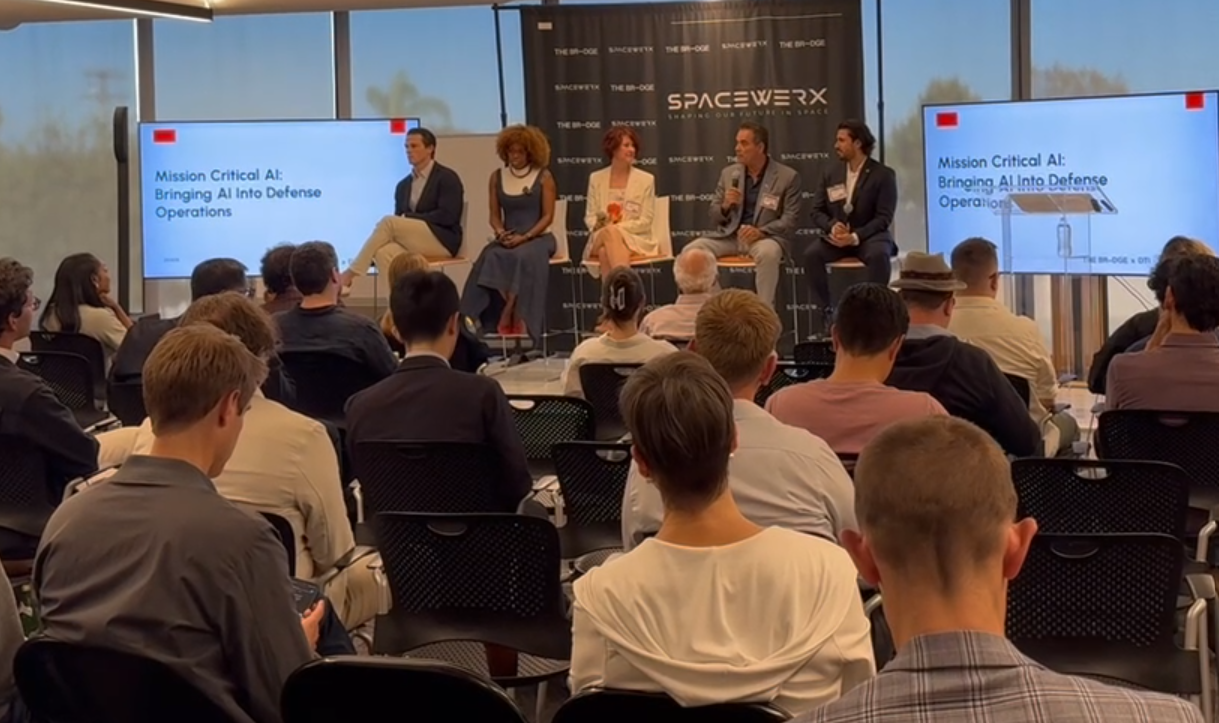
Celeris CEO Angel Martinez, second from right, shares his insights on Mission Critical AI
ANAHEIM, Calif. — October 19, 2026 — Celeris Systems, Inc. is proud to highlight the participation of its President and CEO, Angel Martinez, in the Mission Critical: AI in Aerospace + Defense Tech event held October 14, 2026, in El Segundo, California, as part of LA Tech Week.
Martinez participated in the panel discussion “Mission Critical AI: Bringing AI Into Defense Operations,” joining a distinguished group of military and industry leaders to explore the opportunities, challenges, and practical considerations associated with integrating artificial intelligence into mission-critical defense environments.
“It was a tremendous honor to share the stage with such a distinguished panel of leaders and contribute to an event focused on advancing innovation in aerospace and defense,” said Martinez. “The exchange of perspectives was invaluable, particularly as our industry works to move AI beyond experimentation and into trusted, operational capabilities.”
Moving Beyond AI Demonstrations: Entering the Trust Phase
During the discussion, Martinez characterized the current stage of AI adoption in defense as “the trust phase,” emphasizing that the ultimate value of artificial intelligence lies not simply in generating information faster, but in producing results that can be trusted, independently verified, and confidently acted upon. Drawing on more than two decades of Celeris Systems' experience in systems engineering, integration, test and evaluation, and mission assurance, Martinez highlighted the opportunity to improve engineering efficiency and mission-readiness decisions through AI-enabled digital engineering.
Celeris' patented iRIS digital engineering platform has supported the management of test and evaluation baselines for major U.S. Space Force programs since 2011. Originally developed using company-funded investment, iRIS has undergone extensive modernization over the past three years, supported largely by Small Business Innovation Research (SBIR) awards. The next-generation platform, iRIS Gen2, incorporates AI-enabled engineering workflows and mission decision support, with a targeted release in December 2026. Through pilot activities combining conventional automation and AI-enabled capabilities, Celeris has demonstrated 2–5 times faster verification planning and mission-readiness decision workflows, highlighting the potential to significantly reduce administrative burdens while improving access to critical engineering information. “Ultimately, the real value of AI in defense isn't how quickly it can generate an answer,” Martinez explained. “It's how confidently we can trust and act on that answer.”
Bridging the Gap Between Innovation and Operational Deployment
Martinez also addressed one of the defense industry's most persistent challenges: transitioning promising technologies from successful demonstrations into operational environments. He identified cybersecurity authorization, access to authoritative data, interoperability, and common data ontologies as essential technical considerations. Equally important are the acquisition strategies, funding mechanisms, and organizational commitments necessary to sustain a capability beyond its initial demonstration. Celeris is actively working with Space Systems Command toward establishing a Phase III SBIR contracting pathway to support the transition of its technology into operational use. “A successful pilot demonstrates technical value. A successful transition delivers mission value.” Martinez emphasized that transition planning, cybersecurity, and mission integration must be considered from the earliest stages of technology development rather than addressed after a successful prototype.
Building Mission Confidence Through Verification
Reflecting Celeris' longstanding expertise in test and evaluation, Martinez outlined four fundamental considerations for establishing confidence in mission-critical AI capabilities:
Authoritative data and traceability: Ensuring AI outputs are grounded in controlled, reliable information.
Independent verification: Evaluating capabilities against representative operational scenarios, expected outcomes, and failure conditions.
Human accountability: Maintaining appropriate human oversight and the ability to question AI-generated recommendations.
Cybersecurity and sustainment: Ensuring solutions can be securely deployed, integrated, maintained, and supported throughout their operational lifecycle.
These principles reflect Celeris' approach to developing AI-enabled digital engineering solutions that prioritize reliability, transparency, and mission assurance.
Supporting the Next Generation of Defense Innovators
Martinez concluded by encouraging aspiring defense technology entrepreneurs to plan for operational transition from the outset, establish relationships with government mission champions, seek experienced SBIR guidance, and incorporate cybersecurity requirements early in development. “A great pilot without a path to production is still just a pilot.”
Celeris Systems extends its sincere appreciation to the event organizers, moderators, fellow panelists, and attendees for creating a valuable forum for collaboration and thought leadership. “Being part of this distinguished panel was both an honor and a privilege,” Martinez added. “It reinforced the importance of collaboration between government, industry, and the innovation community as we work together to advance trusted AI capabilities in support of our nation's defense missions.”
About Celeris Systems, Inc.
Founded in 2005 and headquartered in Anaheim, California, Celeris Systems, Inc. is a Hispanic-owned small business specializing in systems engineering, integration, test and evaluation, digital engineering, and mission assurance for complex aerospace and defense programs. Celeris is the developer of iRIS, a patented digital engineering platform supporting requirements management, verification planning, technical baseline management, engineering traceability, and mission decision support.
Celeris Systems CEO Joins Distinguished Panel of Aerospace and Defense Leaders at LA Tech Week
Angel Martinez shares insights on trusted AI, mission readiness, and transitioning innovative technologies into operational defense capabilities.